
Where it started
When I first arrived in Chongqing in 2011 as an overseas student learning Chinese, I never imagined I would still be here more than a decade later, teaching English to young learners and primary school students. In 2013, I began my career as an ESL teacher, shaped by my own experience growing up in a traditional education system. My classes were lively and creative at times, but I didn't yet have a clear framework to connect those activities to a bigger learning philosophy.
Discovering the IB approach felt like opening a door to a world I had been looking for without knowing it. The focus on inquiry, student agency, and global mindedness resonated deeply with me. It challenged me to rethink my role — not just as someone who teaches English, but as a guide who helps students explore the world, develop empathy, and build skills for life.
Discovering the IB approach felt like opening a door to a world I had been looking for without knowing it.
Growth along the way
Learning digital tools like Canva and Padlet, embodying the IB Risk-Taker profile, and building confidence in trying innovative lesson structures.
Gaining insights from peers worldwide and learning to see feedback as growth — including through Windsor University cohort work with educators across four continents.
Linking English lessons to global issues — environmental topics, cultural exchanges, AI and society — to build genuine Global Citizenship skills.
Designing lessons where student questions lead learning, creating space for personal voice, and fostering independence and Inquirer skills from Grade 1 through Grade 8.
"Is this still English class?"
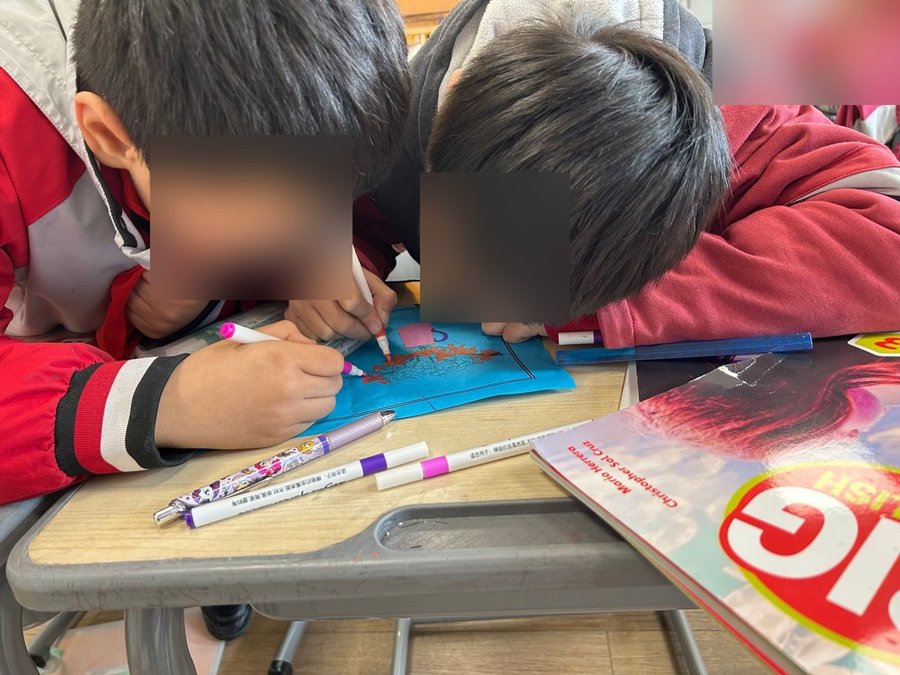
One moment that's stayed with me: during a Grade 3 Women's Day card-making lesson — done entirely in English, honoring inspiring women — a student asked, "Is this still English class?" It was proof that learning can be personal, creative, and still academically rigorous. Looking back, my early years as an ESL teacher already had "IB-like" ideas in them — storytelling, cultural projects, real-world topics — just without a structured framework yet.
IB principles I champion
Students learn through questions, not just about topics. Every unit begins with something students genuinely want to understand.
Students have voice, choice, and ownership. They interview family members, lead showcases, and set their own learning goals.
Language as a bridge to global perspectives. Students explore Chinese and Western storytelling, restaurant cultures, and world festivals side by side.
Continual self-assessment, for both teacher and student. Not a graded form at the end of a unit — a genuine habit of mind.
The Moreland chapter
Completing my M.Ed. in Early Childhood Education at Moreland University (January 2026) under Dr. Sonja Lopez Arnak was the missing link between my instincts and my practice. For the first time, I felt that everything I had learned — years ago and more recently — was finally coming together in a meaningful way. The program pushed me to apply theory to real classrooms, critique it, and connect it directly to the children sitting in front of me in Chongqing.
It also gave me a new vocabulary for what I already believed: Vygotsky's ZPD explained why scaffolding my Grade 2 storytelling unit the way I did was the right call. Gardner's Multiple Intelligences validated every time I'd chosen music, movement, or drawing over a worksheet. Tomlinson's differentiation model gave me language for what I was already trying to do with my bilingual assessment comment banks.
Why IB — honestly
If someone asks me "why IB?", my first honest reaction would be: because it's trending in Chinese international schools right now. But if I only said that, it would be far from the truth by now. When I finished my M.Ed., I wanted to keep learning something that would strengthen my teaching, and my Moreland classmates recommended IB. So at first, yes — I went with the trend. Then the more I learned, the more I fell in love with the whole system. Not love at first sight. More like falling in love after the hundredth sight of those IB documents.
During the M.Ed. we studied many different approaches — Head Start, Montessori, Reggio Emilia, Waldorf, green schools, the Finnish model — and got familiar with Common Core. I could see the value in each of them. But IB is still my favorite, even when people say it can be vague. Maybe because it doesn't hand you a script. It trusts the teacher to think.
Where this is heading
In July 2026, I received the Outstanding Teaching Design Award from Zandem Academy. It was the first time the school's leadership formally acknowledged the IB-aligned approach I had been building into my classes, and it confirmed that the direction is right.
From September, I'm embedding inquiry questions into every unit, integrating global themes, and designing cross-curricular projects with colleagues. My goal isn't only to transform my own classroom, but to help my school grow into a leading IB institution in Chongqing — and one day, in China.