The question that started it
I had been asking myself for months: why do my students still need me if AI can generate a personalised English lesson in seconds? What is the purpose of a language classroom if students can already practice speaking with AI 24/7? What if we knew exactly which parts of language acquisition require human connection — what would that change about how I plan my lessons?
The answer I kept returning to is this: my real role is not grammar transfer. It is teaching cultural knowledge, intercultural relationships, and language as connection. What AI cannot replicate is the moment a student feels genuinely heard in a second language. No tool creates that.
What I was doing was really just trial and error — long hours of AI chats with a lot of defective results. Joe Dale's webinar showed me that there is a professional way for language teachers to do this. Workflows that actually connect. Tools that build on each other. I didn't need to be convinced. I just needed to see it done properly.
What Joe Dale's webinar changed
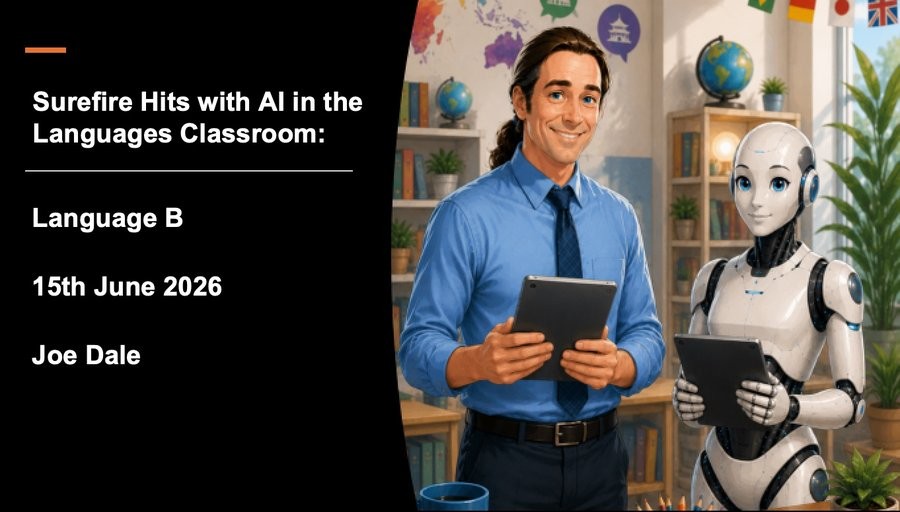
In June 2026, I attended Joe Dale's IB Exchange webinar, "Language B: Surefire Hits with AI in the Languages Classroom." It was one of the most practically useful professional learning sessions I'd been to in a while — not because it told me AI is coming, but because it showed specific ways to use it as a teaching tool rather than a shortcut around teaching.
My LinkedIn post after the session reflected on what stood out: the idea that AI tools, used well, can give language learners more low-stakes practice and more chances to use English for real purposes — not just performing it for a grade.
My questions for the field
What are the reasons a student can ace an AI quiz but freeze the moment a real person asks them something unexpected?
What would change if teachers stopped competing with AI and focused only on what AI cannot replicate?
If the relationships built in a classroom matter more to language acquisition than the quality of the input — what does that mean for how schools are designed?
What are the reasons different age groups still need their teacher in different ways — and does that need ever fully disappear?
What this looks like in practice
- Differentiated texts — using AI tools to generate reading texts at multiple levels for the same topic, so all students access the same inquiry content regardless of English proficiency
- Culturally grounded prompts — AI-generated speaking prompts that connect to students' own contexts: Chongqing landmarks, Chinese festivals, family stories
- Authentic writing tasks — designing assessment tasks where authenticity matters so much that AI shortcuts become obviously irrelevant
- Bilingual resource creation — using AI to support teachers in producing bilingual materials faster, so collaborative planning time is spent on thinking, not formatting
On AI detection and authentic writing
Working with AI tools in my own professional writing has also made me more attuned to what authentic student writing looks and sounds like — and more intentional about designing tasks that invite real voice rather than polished performance. When a student writes something only they could have written, no detector is needed.
Published reflection — LinkedIn Pulse, June 2026
"Reflections on an Extraordinary Afternoon of AI in Language Teaching" — published on LinkedIn Pulse following Joe Dale's IB Exchange webinar
What stayed with me most was the workflow itself: watching one topic turn into a lesson plan, then a song, a dialogue, a reading text, a quiz, and an illustrated worksheet — all connected rather than separate. I teach English Language Acquisition at an IB Candidate School, and this is exactly what I needed: something I can actually use in my classroom, not just watch and think it's nice.
I was one of 421 participants in the room. What made the session different from most professional learning wasn't the tools themselves — it was seeing them chained together into a coherent workflow. One topic, one thread, one lesson: a song, a dialogue, a reading text, a quiz, an illustrated worksheet. For an IB Language Acquisition teacher managing 200+ students across Grades 1–8 in a bilingual school in Chongqing, that kind of connected design is exactly what classroom-ready looks like.
The China context added an honest layer: some of the tools discussed aren't accessible here. But that didn't make the session less useful — it made it more interesting. I left with a clearer picture of what I was looking for, and a sharper sense of how to adapt what works in other contexts to what works in mine.
Also available as a full blog post with additional reflections from the weeks since the webinar.
Looking ahead
As BI Zandem moves toward IB authorization, I'm exploring how AI tools can support teachers as well as students — particularly for assessment feedback, bilingual resource creation, and professional collaboration. The question I keep coming back to isn't "how do we use AI." It's what AI shows us about what our classrooms were missing all along.